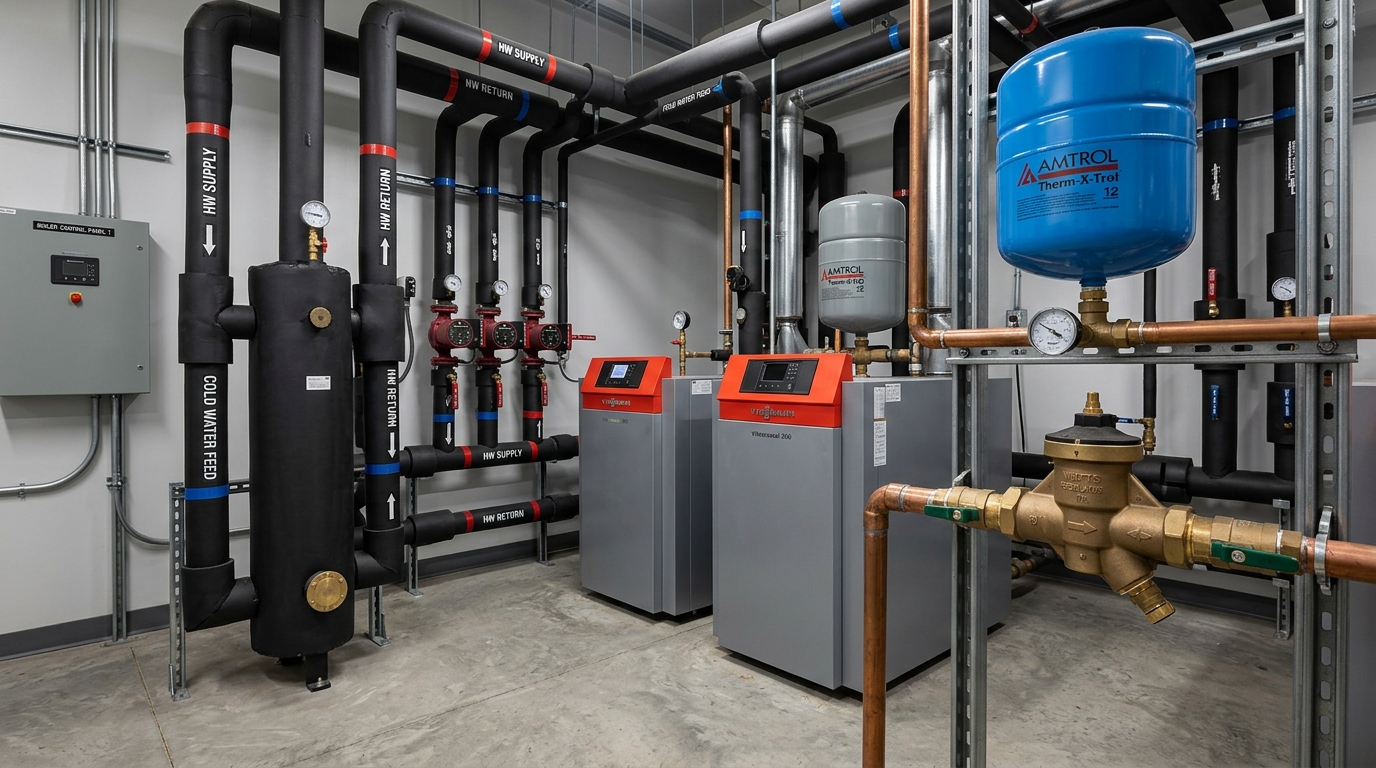
📌 2026 Direct Cost & Engineering Answer: In Toronto and the GTA, annual commercial closed-loop water treatment programs (quarterly lab chemistry sampling + nitrite/molybdate inhibitor replenishment) typically range from $1,400 to $3,800 CAD/year for small/mid-size buildings and $3,500 to $7,500+/year for large multi-loop condo towers. One-time dirty-loop chemical flushing and passivation ranges from $1,800 to $9,500+ depending on system gallonage.
1. 2026 Closed-Loop Water Treatment & Flushing Cost Table (Toronto & GTA)
Property managers looking after high-efficiency condensing boilers, central chillers, and suite fan-coil heat-pump loops across Toronto, Mississauga, Vaughan, and Hamilton routinely ask whether water treatment is a low-cost preventative line item compared to heat exchanger replacement. A single scaled stainless boiler heat exchanger costs $25,000–$60,000+—making clean loop chemistry one of the highest-ROI mechanical budgets in a building:
| Program / Service Scope | Building / System Size | 2026 GTA Estimate (CAD) | Key Deliverables |
|---|---|---|---|
| One-Time Baseline Audit & Lab Chemistry Panel | 1 – 3 Hydronic Loops | $495 – $950 | pH, conductivity, dissolved iron/copper, nitrite/molybdate residuals, bacterial count & report. |
| Annual Quarterly Closed-Loop Treatment | Commercial Plaza / Low-Rise (1–2 Loops) | $1,400 – $2,800 / yr | Quarterly technician visit, buffered inhibitor dosing, filter bag swaps, written logbooks. |
| Full High-Rise Tower Program (Chiller + Heating) | High-Rise Condo / Office (3–5+ Loops) | $3,500 – $7,500+ / yr | Monthly/quarterly visits, corrosion coupon monitoring, biocide shock & make-up water audit. |
| Side-Stream Bag & Magnetic Filter Installation | 5–25 Micron Stainless + Neodymium | $1,800 – $4,200 | Continuous magnetite (Fe₃O₄) capture protecting ECM variable-speed pumps & plate heat exchangers. |
| Degraded Loop Chemical Flush & Passivation | Fouled Heating / Chilled System | $2,200 – $9,500+ | Dispersant circulation, system bleed & recharge, fresh corrosion inhibitor passivation. |
2. Target Closed-Loop Chemistry Specifications (Why Boiler Makers Void Warranties)
Modern aluminum-silicon and stainless-steel condensing boilers operate with razor-thin 1.5 mm waterway passages. Boiler manufacturers routinely void factory heat-exchanger warranties if loop water fails any of these Ontario mechanical benchmarks tested during our water laboratory testing visits:
- Target pH Window: Carbon steel and copper mixed loops must sit between pH 8.5 and 10.0 (while aluminum heat-exchanger boilers require tight 7.5–8.5 neutral non-caustic buffering so alkaline water does not pit aluminum!).
- Low Turbidity & Suspended Solids: Cloudy brown or black water destroys gland seals and clogs suite thermostatic fan-coil actuators.
- Active Inhibitor Residuals: Buffered Nitrite (500–1,000 ppm) or Azole/Molybdate inhibitor levels protect carbon steel, copper, brass, and stainless surfaces simultaneously via tailored chemical treatment programs.
- Zero Air/City Water Dilution: Every time a domestic make-up PRV leaks fresh Toronto water into your heating header, dissolved oxygen spikes corrosion exponentially—and requires an annual OWWA backflow check.
3. Three Signs Your Closed Loop Needs Immediate Flushing
- Frequent Electronic Circulator Pump & Seal Failures: Abrasive black magnetite particles chew through silicon-carbide seal faces inside months of replacement.
- Uneven Floor Heat & "Cold Suite" Service Calls: Sludge settles in horizontal balancing valves and low-velocity radiant manifolds, choking off GPM flow even with healthy pump amps.
- Slime, Sulphite Drops, or Rotten-Egg Odor in Chilled Loops: Unchecked anaerobic sulfate-reducing bacteria (SRB) consume nitrite inhibitors quickly and trigger aggressive under-deposit pinhole leaks along copper risers requiring chemical loop cleaning & disinfection. Installing standardized corrosion coupon racks and valved sample ports across every mechanical floor lets superintendents pull clean baseline water samples cleanly during routine rounds without depressing system static pressure or introducing entrained air pockets.
4. How Bundling Closed-Loop + Cooling Tower Treatment Reduces Spend
Facilities with open cooling towers (governed under ASHRAE Standard 188 and Hamilton Cooling Tower Registry By-law 11-078) alongside closed-loop boiler and chiller circuits save 20%–30% by combining both systems under one certified contractor—pairing Legionella compliance, chemical supply, and yearly mechanical backflow compliance into one consolidated report.
Before signing any annual commercial mechanical treatment agreement across Mississauga, Brampton, Vaughan, Markham, or Oakville, verify three non-negotiables: first, confirm your vendor conducts actual bottle-drawn lab verification rather than relying solely on handheld conductivity wands; second, verify whether mild carbon steel vs. aluminum condensing boiler heat exchangers require separate non-caustic inhibitors; and third, require clear written documentation showing nitrite/molybdate residuals, pH trends, dissolved iron/copper ppm, and side-stream filter delta-P pressures after every quarterly visit so warranty claims, insurance records, and condo reserve fund audits remain 100% protected across every seasonal startup and winter peak heating cycle.
Frequently Asked Commercial Water Treatment Questions
1. How much does a monthly or quarterly closed-loop water treatment contract cost in Toronto?
A commercial office building or low-rise condo with 1-2 loops typically pays $1,400 to $2,800/year for quarterly site sampling, chemical adjustments, and digital reports. Large high-rise towers operating separate heating, chilled, condenser, and glycol loops range from $3,500 to $7,500+/year.
2. Why is my building's closed-loop water turning black with magnetite sludge?
Black iron-oxide magnetite sludge (Fe3O4) indicates dissolved oxygen ingress—commonly caused by leaking pump packing, failing bladder expansion tanks, or auto-fill city make-up lines constantly introducing fresh oxygenated Toronto water into the closed piping network.
3. Are monthly or quarterly site visits standard for closed-loop HVAC systems?
Under ASHRAE and manufacturer warranty specifications for condensing high-efficiency boilers (Viessmann, Lochinvar, Fulton, Aerco), commercial closed loops should be sampled quarterly with chemical pot-feeder and magnetic filter checks.
4. What does a pre-commission flush cost for newly welded commercial piping?
New black-iron and copper commercial heating/chilled loops contain cutting oils, mill scale, and soldering flux that foul ECM pump rotors immediately if left untreated. Pre-commission alkaline flush and passivation typically runs $1,800 to $6,500 depending on loop volume.
Request a Free Water Treatment & Glycol Audit
Schedule on-site conductivity, pH, refractometer glycol concentration, or lab sample pickup across Toronto & the GTA. Call (416) 578-3471.